The Cry of the Spirit: A Different Theory of Human Unhappiness
Human beings have always struggled to explain unhappiness.
The problem is not suffering itself. Most people understand why they suffer when they are hungry, injured, threatened, lonely, or grieving. These forms of pain have obvious causes. They are connected to real conditions in the world.
The greater mystery is a different kind of unhappiness.
It is the unhappiness that appears when survival has already been secured.
A person may have food, shelter, safety, employment, friends, and opportunities. They may be healthier and wealthier than most human beings who have ever lived. Yet they remain dissatisfied. Something feels incomplete. Something feels absent. There is a persistent sense that life should contain more than it currently does.
This condition is so widespread that many people consider it normal. They assume that dissatisfaction is simply part of being human. Others attempt to explain it through psychology, economics, biology, or culture. Some blame modern society. Some blame capitalism. Some blame religion. Some blame technology. Some blame themselves.
Yet none of these explanations seem entirely sufficient.
The question remains: why do human beings continue to experience profound inner dissatisfaction even when many of their material needs have already been met?
SoulCredo proposes a different answer.
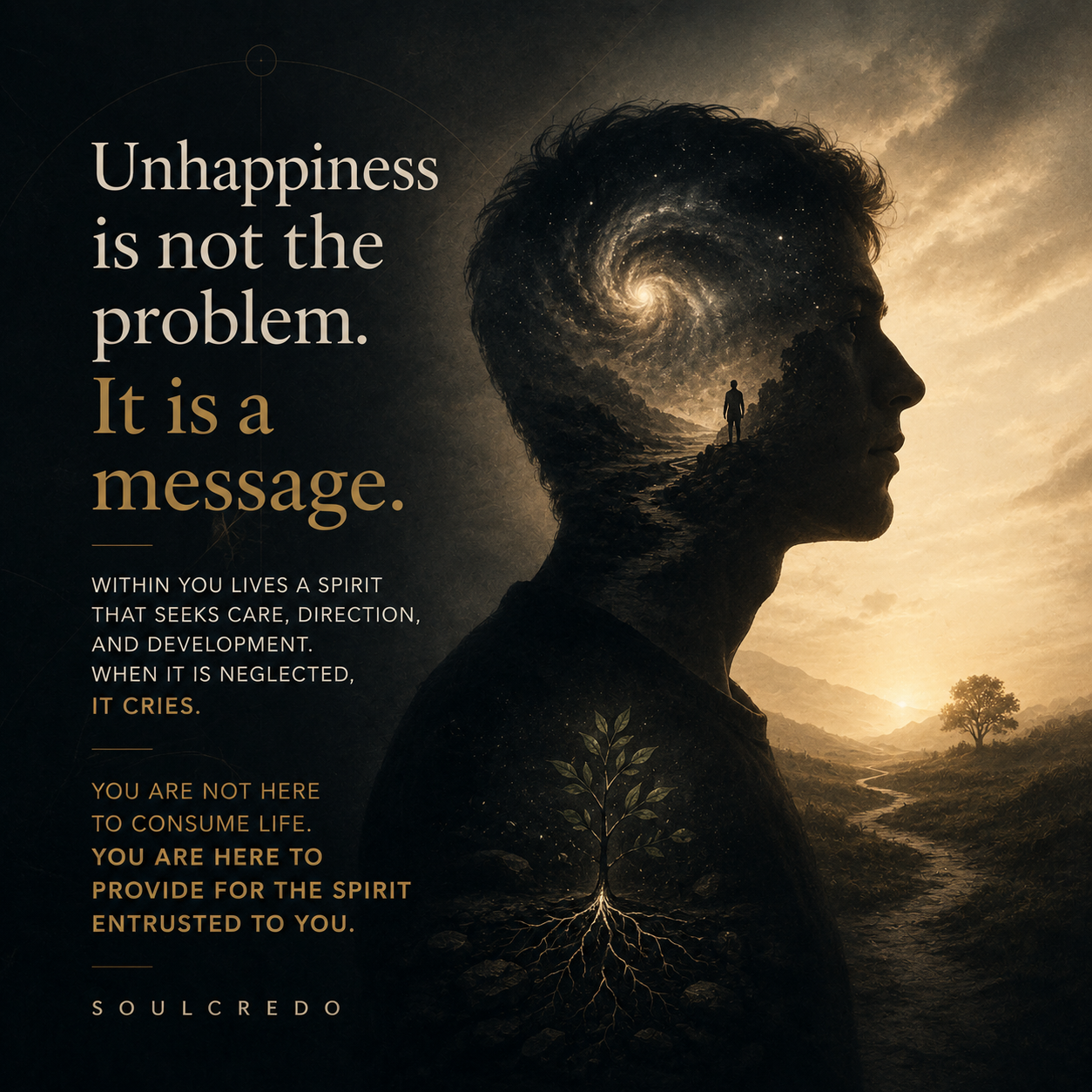
It begins with the possibility that what we call unhappiness is not merely a psychological malfunction. It may be a signal. It may be the expression of a deeper need that modern people have forgotten how to recognize.
It may be the cry of the Spirit.
This idea requires careful explanation because the word “Spirit” carries considerable historical and religious baggage. In the context of SoulCredo, Spirit should not initially be understood as a supernatural being, a deity, or an object of worship. Rather, Spirit refers to the living essence within conscious existence. It is that aspect of life that seeks growth, meaning, development, and fulfillment.
Whether one views Spirit as metaphysical reality or philosophical metaphor is ultimately less important than the role it plays in understanding human experience.
The central claim is simple.
Human beings do not merely possess bodies that require maintenance. They also possess an inner reality that requires care.
Modern civilization has become highly skilled at serving the body. We understand nutrition, medicine, exercise, hygiene, and material comfort. Entire industries exist to improve physical well-being.
Yet despite unprecedented material progress, many people continue to experience inner unrest.
This suggests that the body may not be the only thing that suffers neglect.
To understand this possibility, it is worth considering the unique position of humanity within life itself.
Animals survive.
Plants grow.
Living organisms adapt to their environments.
Human beings do all of these things as well, but they possess an additional capacity. They can reflect upon existence itself. They can question the nature of reality. They can contemplate death. They can imagine futures that do not yet exist. They can investigate their own minds.
Human consciousness appears to be life becoming aware of itself.
Whether one interprets this through evolution, philosophy, spirituality, or some future understanding that has yet to emerge, the fact remains that human beings occupy a remarkable position within nature. Through us, the universe has acquired the ability to examine itself.
If consciousness is not merely an accident but a meaningful development within life, then it carries implications.
Consciousness is not only a privilege.
It is also a responsibility.
SoulCredo proposes that every conscious person serves as a guardian for the Spirit entrusted to them.
This idea immediately transforms the way unhappiness is understood.
Most modern theories view unhappiness as a problem to eliminate. The objective becomes distraction, relief, treatment, management, or escape.
SoulCredo approaches the matter differently.
When a child cries, the crying itself is not the problem. The crying is a signal. It communicates that some need has not been met.
The responsible response is not to silence the child. The responsible response is to discover the cause.
The same principle may apply to existential dissatisfaction.
What if inner unrest is not evidence that something is wrong with us?
What if it is evidence that something within us requires attention?
Modern life offers countless methods of escaping this possibility.
Entertainment provides temporary distraction.
Consumption provides temporary stimulation.
Achievement provides temporary validation.
Status provides temporary significance.
Pleasure provides temporary relief.
None of these are inherently harmful. Many are valuable and meaningful parts of life. The problem arises when they are expected to solve a problem they were never designed to solve.
The reason many people remain dissatisfied after achieving success is not necessarily because success lacks value. It is because success and fulfillment are not identical concepts.
A person may become wealthy while remaining internally fragmented.
A person may become famous while remaining internally lost.
A person may achieve professional distinction while remaining disconnected from their own nature.
External accomplishments can improve life dramatically. They cannot automatically resolve inner disorder.
This distinction becomes clearer when we examine the relationship between the soul and the Spirit.
SoulCredo views the soul as the home of the Spirit.
The metaphor is important.
A home can be orderly or chaotic.
It can be safe or dangerous.
It can be well maintained or neglected.
A home influences the well-being of those who live within it.
No reasonable person would expect a child to flourish in an environment characterized by instability, disorder, neglect, and decay. Yet many people expect inner peace while allowing precisely these conditions to dominate their internal and external lives.
They neglect their health.
They avoid responsibility.
They postpone difficult decisions.
They tolerate destructive habits.
They abandon meaningful relationships.
They drift without direction.
They pursue goals that do not reflect their true nature.
Then they wonder why fulfillment remains elusive.
From the perspective of SoulCredo, the answer is straightforward.
The home of the Spirit has fallen into disorder.
The resulting unhappiness is not arbitrary. It is an understandable response.
The Spirit is signaling that something essential requires attention.
This leads to one of the most important principles within the philosophy.
Happiness is not something that can be pursued directly.
Modern culture often treats happiness as an objective. People are encouraged to chase it, maximize it, optimize it, and engineer it. Yet the direct pursuit of happiness frequently produces frustration.
The reason may be that happiness is not a destination.
It is a consequence.
Just as physical vitality emerges from proper care of the body, happiness emerges from proper care of the Spirit.
It is a byproduct of alignment.
This raises an obvious question.
What does it mean to care for the Spirit?
The answer begins with a shift in identity.
Most people see themselves primarily as consumers of life. They ask what life can provide for them. They seek experiences, opportunities, rewards, and comforts.
SoulCredo proposes a different role.
The individual becomes a provider.
A guardian.
A steward.
The fundamental responsibility of a provider is to create conditions in which the Spirit can thrive.
This includes practical realities.
Financial stability matters.
Health matters.
Relationships matter.
Security matters.
Competence matters.
Order matters.
The philosophy does not reject material concerns. On the contrary, it recognizes their importance. The mistake is assuming that material concerns are the ultimate purpose rather than tools serving a higher responsibility.
Money, for example, is neither good nor bad.
Money is a resource.
A capable provider requires resources.
The problem emerges when the acquisition of resources becomes disconnected from meaningful purpose.
Wealth alone cannot satisfy the Spirit because wealth is not the Spirit’s ultimate need.
The Spirit seeks development.
The Spirit seeks growth.
The Spirit seeks fulfillment of potential.
The Spirit seeks harmony between nature and action.
This final point may be the most important of all.
Not every person is meant to pursue the same path.
Modern society often promotes standardized visions of success. Individuals are encouraged to pursue identical goals regardless of their unique predispositions.
Yet nature itself suggests a different pattern.
No two species fulfill the same role.
No two ecosystems depend upon identical forms of life.
Diversity is not an accident. It is a requirement for flourishing.
Human beings are no different.
Each individual possesses distinct psychological tendencies, strengths, limitations, motivations, and capacities.
Some are builders.
Some are teachers.
Some are protectors.
Some are creators.
Some are organizers.
Some are explorers.
Some are leaders.
Some are caretakers.
Problems emerge when individuals attempt to live according to ideals that contradict their own nature.
A person may achieve conventional success while simultaneously moving further away from who they were meant to become.
In such circumstances, achievement may increase while fulfillment decreases.
SoulCredo therefore places great emphasis on self-knowledge.
To know oneself is not an act of self-indulgence.
It is an act of responsibility.
A provider cannot properly care for the Spirit without first understanding the nature of the being entrusted to their care.
This understanding requires honest examination.
It requires recognizing strengths without arrogance and weaknesses without shame.
It requires distinguishing authentic desires from social expectations.
It requires discovering the particular form of excellence toward which one’s own nature points.
The objective is not to become the greatest person imaginable.
The objective is to become the greatest version of oneself.
This distinction changes everything.
Many people spend their lives competing against ideals that were never meant for them. They measure themselves according to standards imposed by culture, family, institutions, or social media. The result is perpetual dissatisfaction because they are pursuing destinies that belong to other people.
SoulCredo rejects this approach.
The purpose of life is not to become someone else.
The purpose of life is to become fully oneself.
When viewed from this perspective, happiness acquires a different meaning.
It is no longer understood as pleasure.
It is no longer understood as comfort.
It is no longer understood as the accumulation of rewards.
Instead, happiness becomes evidence that the relationship between guardian and Spirit is functioning properly.
The soul is in order.
The provider is fulfilling their responsibilities.
Life is aligned with nature.
Growth is occurring.
The cry of the Spirit begins to quiet not because it has been silenced, but because it has been heard.
This does not eliminate hardship.
Every life contains loss, failure, uncertainty, and suffering. SoulCredo does not promise escape from the realities of existence.
Rather, it offers a different interpretation of why human beings suffer when no obvious cause is present.
The deepest forms of unhappiness may not originate from the world around us.
They may originate from our failure to fulfill our responsibility toward the Spirit within us.
If this is true, then the path forward becomes clear.
The task is not endless consumption.
The task is not endless distraction.
The task is not endless pursuit of external validation.
The task is guardianship.
To know oneself.
To develop oneself.
To bring order to the soul.
To provide for the Spirit.
And through that responsibility, to discover a form of happiness that cannot be purchased, borrowed, or imitated, because it emerges from fulfilling the very purpose for which consciousness exists.