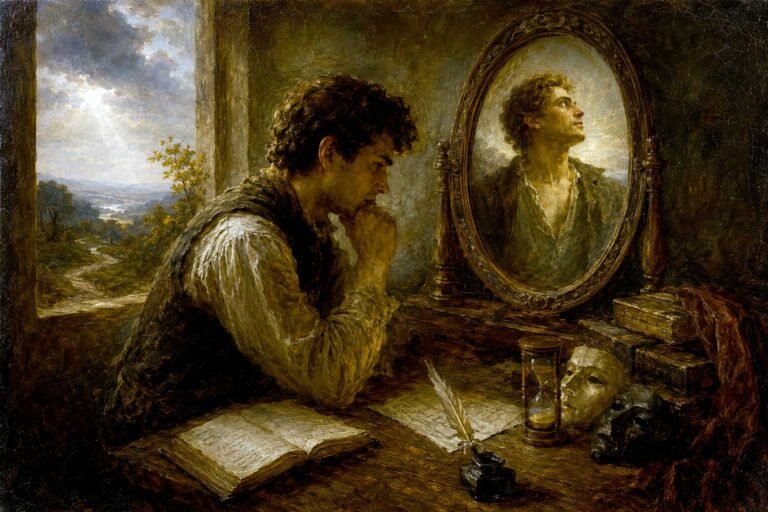
Why Am I Unhappy When My Life Is Generally Good?
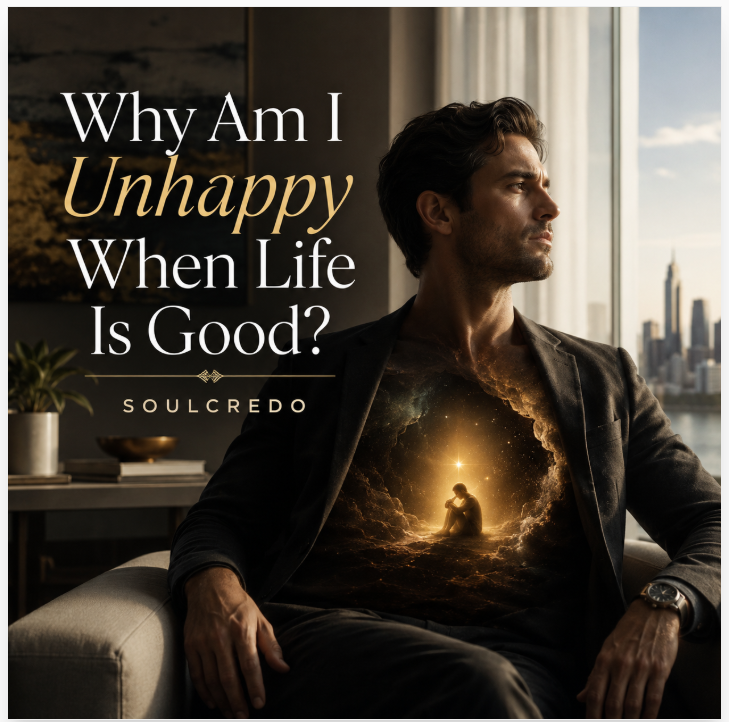
You may have a home, an income, food, safety, relationships, and enough comfort to make previous generations envious.
Nothing is catastrophically wrong.
Yet something inside you is still not at peace.
You wake up with a pressure you cannot clearly explain. You move through the day feeling that something is missing, unfinished, neglected, or slowly dying. You may feel restless when you are supposed to be grateful. You may feel empty during moments that should make you happy.
From the outside, your life appears acceptable.
Inside, something continues to cry.
This creates a second layer of suffering. You are not only unhappy; you feel guilty for being unhappy.
You tell yourself:
“I should appreciate what I have.”
“Other people have much worse problems.”
“There is no legitimate reason for me to feel this way.”
“Why can’t I simply be happy?”
These statements may be reasonable, but they rarely resolve the pain. Gratitude can help us recognize what is good. It cannot always silence the deeper demand operating inside us.
SOULCREDO begins with a question that many philosophical, religious, psychological, and self-development systems answer only partially:
Why do we suffer when life is good?
This is not a discussion of suffering caused by war, hunger, abuse, severe illness, bereavement, or immediate existential danger. Such suffering has identifiable external causes.
The more mysterious condition is unhappiness in the presence of relative safety.
Why does a person who has “enough” continue to experience an internal pressure to become more?
Why does comfort eventually become suffocating? Why happiness is always illusive?
Why do achievement, entertainment, consumption, travel, relationships, and positive thinking often fail to produce lasting peace?
SOULCREDO proposes an answer:
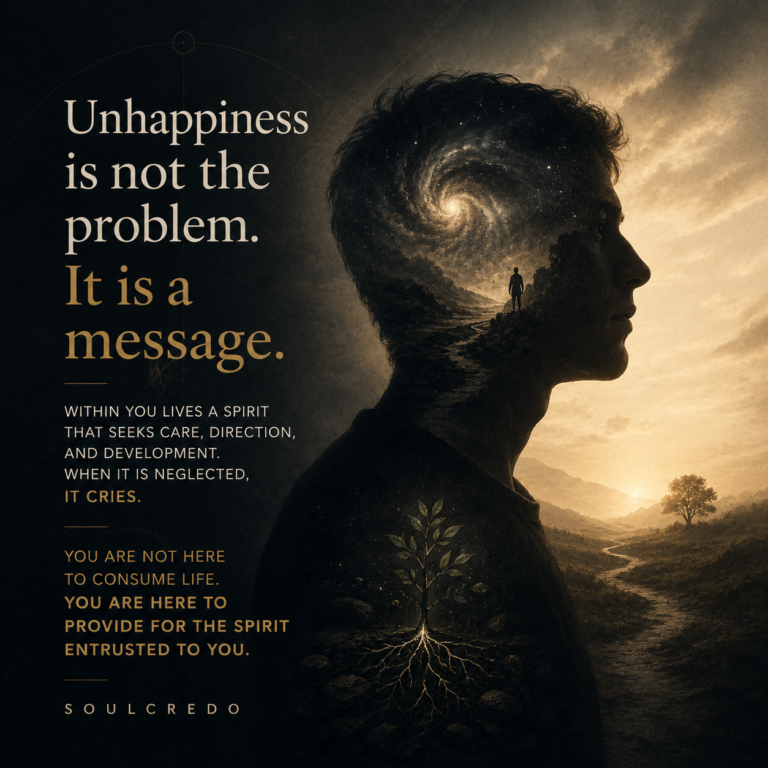
Human beings do not suffer only because they lack pleasure. They also suffer when the force of life within them is not being adequately expressed.
That suffering is the inner cry.
Happiness May Not Be What We Think It Is
Modern culture often defines happiness as a positive emotional state.
We imagine happiness as pleasure, excitement, optimism, comfort, amusement, relaxation, or satisfaction. We pursue experiences that create these feelings and avoid experiences that disturb them.
But positive emotions are temporary by nature.
A vacation ends. A purchase becomes ordinary. Praise loses its intensity. A promotion becomes a new routine. A romantic connection becomes familiar. Entertainment distracts us for several hours, but the old uneasiness returns when the screen goes dark.
This does not mean pleasure is bad. Pleasure is part of life. Rest, celebration, beauty, intimacy, food, art, and enjoyment have real value.
The mistake is expecting pleasure to accomplish a task it was never designed to perform.
Pleasure can stimulate us.
It can reward us.
It can temporarily soothe us.
But it cannot necessarily settle the deeper conflict within the soul.
SOULCREDO offers a different working definition:
Happiness is the absence of soul pain.
This does not mean permanent excitement or uninterrupted joy. It means that the central part of you is no longer tearing against the life you are living.
You may still experience disappointment, fatigue, grief, frustration, fear, and physical pain. But beneath those experiences, there is a sense that you are participating in your own existence rather than abandoning it.
Soul pain appears when there is a fundamental contradiction between what is alive within you and what you are allowing yourself to become.
It is the pain of neglected potential.
The pain of unused strength.
The pain of avoided responsibility.
The pain of invisibility.
The pain of knowing, however quietly, that your current way of living does not adequately represent what you could contribute.
The Inner Cry
Most people have experienced the inner cry, although they may use different language to describe it.
They may call it anxiety, emptiness, restlessness, meaninglessness, dissatisfaction, existential dread, spiritual hunger, stagnation, or a crisis of identity.
The language changes. The underlying experience is recognizable.
Something inside demands movement.
It says:
Become stronger.
Become more capable.
Use what you have been given.
Do not disappear.
Do not waste your life.
Do not become irrelevant to yourself.
Create something.
Protect something.
Develop something.
Contribute something.
Become someone whose existence carries weight.
This demand can feel cruel because it does not disappear simply because we are tired. It may continue even after we have survived difficult circumstances and earned the right to rest.
At first, rest feels like relief.
Eventually, prolonged disengagement can begin to feel like decay.
The inner cry is not always asking for more money, fame, status, or public recognition. Its demands differ from person to person.
For one person, it may demand intellectual work.
For another, physical strength.
For another, leadership.
For another, artistic creation.
For another, service, parenthood, teaching, entrepreneurship, community building, spiritual inquiry, or disciplined self-mastery.
The specific expression is individual.
The deeper principle is universal:
Life within us seeks expression through us.
When that expression is blocked, ignored, or repeatedly postponed, the energy does not simply vanish. It often turns inward.
What might have become disciplined ambition becomes anxiety.
What might have become creation becomes rumination.
What might have become leadership becomes resentment.
What might have become physical development becomes lethargy.
What might have become meaningful social participation becomes loneliness.
What might have become service becomes self-absorption.
The unused force begins to consume the person who refuses to direct it.
The Divine Spark
SOULCREDO interprets the force of life metaphysically.
Its central belief is that God is one, but not yet complete. The Divine is not understood merely as a finished being located somewhere outside the world. God is understood as becoming through life.
Every living being carries a fragment, expression, or spark of that developing totality.
This spark is not a miniature human personality living inside the body. It is the living demand toward survival, expansion, development, creation, adaptation, and greater capacity.
It is the force that insists upon life.
SOULCREDO calls this force the Divine Spark.
It may also be imagined as the Baby God within the soul.
The metaphor of the Baby God is intentionally uncomfortable.
A baby is vulnerable, but it is also demanding. It does not calmly explain its requirements. It cries. It does not care whether the caretaker is tired, confused, embarrassed, or busy. Its need announces itself with absolute urgency.
The inner force behaves in a similar way.
It does not always communicate through elegant thoughts. It often communicates through pain, agitation, envy, shame, frustration, longing, and internal pressure.
These experiences can feel dark. They can appear selfish or even hostile.
But SOULCREDO asks us to consider another possibility:
What feels like an enemy may be an undeveloped force asking for responsible care.
The inner cry may not be proof that you are broken.
It may be evidence that something essential has been neglected.
You Are Not the Baby God
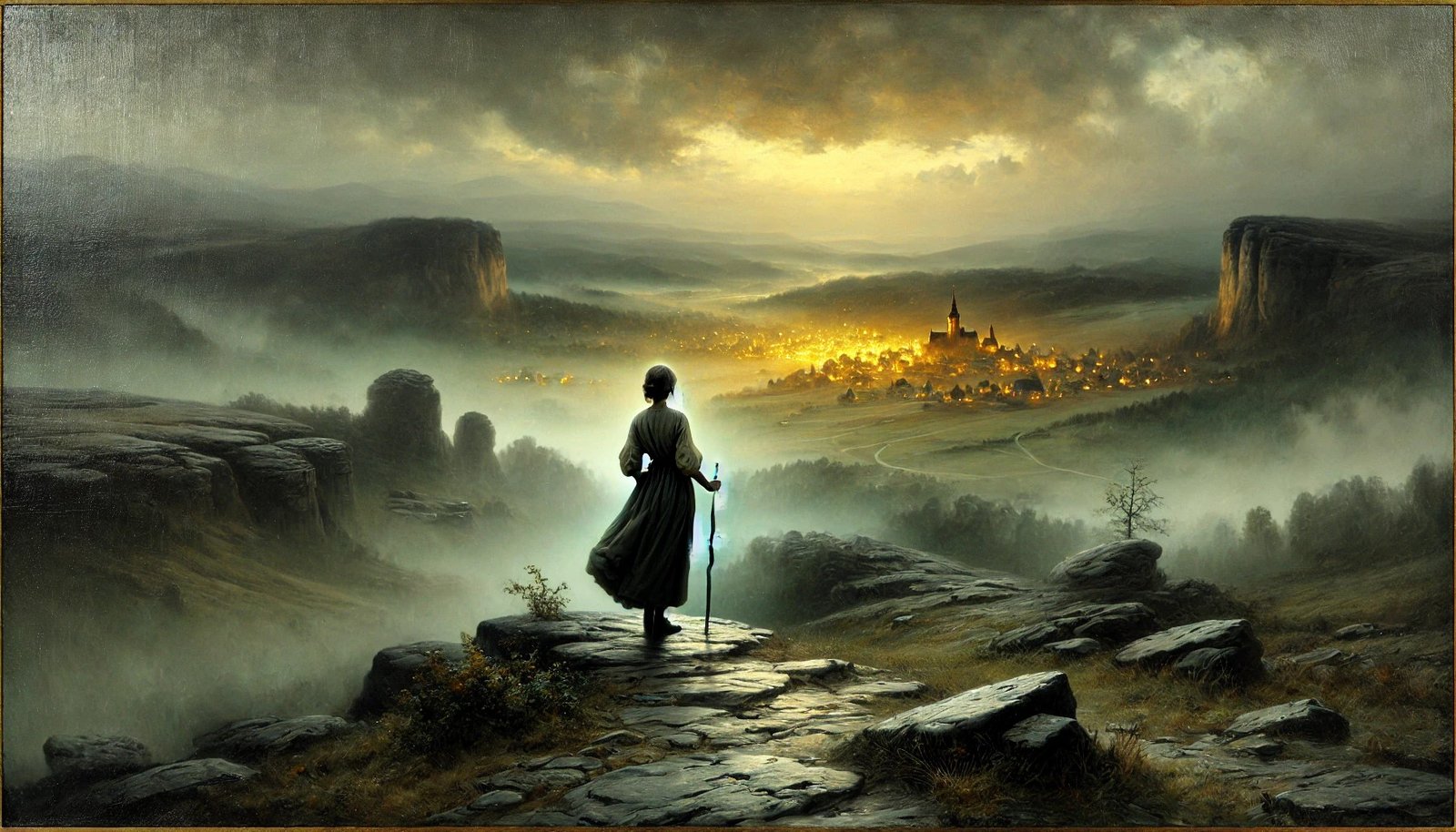
A central distinction in SOULCREDO is the difference between the Divine Spark and the conscious self.
You are not merely the collection of demands arising inside you.
You are the Guardian of those demands.
You are the conscious caretaker of the life entrusted to you.
This changes the relationship between consciousness and desire.
Many systems present only two options.
The first is obedience: follow every desire, impulse, ambition, appetite, and craving.
The second is suppression: eliminate desire, renounce ambition, detach from worldly goals, and silence the ego.
The Guardian follows neither extreme.
A responsible guardian does not give a child everything it demands. Nor does a responsible guardian abandon the child because its crying is inconvenient.
The Guardian listens, interprets, disciplines, protects, and provides.
Some inner demands are legitimate signals.
Others are distorted attempts to satisfy a legitimate need.
You may believe you need admiration from a particular person when you actually need to rebuild your self-respect.
You may believe you need more money when you actually need control, competence, or security.
You may believe you need fame when you actually need meaningful recognition from a smaller community.
You may believe you need constant entertainment when you actually need recovery from exhaustion.
You may believe you need to abandon your life when you actually need to stop living in a way that continuously violates your nature.
The Guardian must learn to distinguish the underlying need from the immediate impulse.
This requires honesty.
Not positive thinking.
Not self-condemnation.
Not indulgence.
Honest guardianship asks:
What is genuinely neglected?
What part of my life has become weak?
Where have I surrendered responsibility?
What capacity am I refusing to develop?
What truth have I avoided because acting upon it would be difficult?
What does the inner cry need from me—not for ten minutes, but for the next stage of my life?
Why Distraction Does Not Work
When the inner cry becomes painful, the natural response is to escape it.
We keep ourselves busy.
We scroll.
We drink.
We consume.
We fantasize.
We argue about politics.
We obsess over other people.
We pursue approval.
We repeat spiritual slogans.
We create emergencies.
We remain in constant communication so we never have to encounter ourselves in silence.
These behaviours are not all equally harmful. Many ordinary pleasures and activities are healthy in moderation.
The problem begins when they are used primarily as anaesthesia.
Anaesthesia is not peace.
It is the temporary suspension of awareness.
A person can spend years constructing a life designed to prevent contact with the inner cry. Every quiet moment is filled. Every difficult question is postponed. Every sign of dissatisfaction is interpreted as something to medicate, purchase, affirm, suppress, or blame on someone else.
But the neglected force remains.
It may return as irritability.
It may appear as chronic comparison.
It may turn into contempt for people who are attempting what we are afraid to attempt.
It may emerge as sudden despair after retirement, divorce, career disruption, children leaving home, physical ageing, or the end of a long-term goal.
The external structure changes, and the person discovers that the internal question was never answered.
Who am I when nobody urgently needs me?
What am I developing now?
What am I serving?
Where is my life moving?
What reason do I have to remain fully alive?
Without a serious answer, comfort can become a beautifully furnished waiting room.
Why Achievement Alone Also Fails
If distraction fails, perhaps achievement will save us.
Sometimes it does help.
Developing competence, financial stability, social standing, physical health, and meaningful work can calm important forms of inner distress. Human beings need evidence that they can affect the world and contribute to it.
Respect matters.
Usefulness matters.
Health matters.
Money matters.
Belonging matters.
Competence matters.
Recognition matters.
It is naïve to pretend that these things are spiritually irrelevant.
A person who is chronically powerless, isolated, financially insecure, physically neglected, or treated as insignificant may experience intense soul pain. Practical improvements can therefore have profound psychological and spiritual effects.
But achievement becomes another trap when it is pursued without understanding.
A person may accumulate more and remain terrified of losing everything.
They may achieve status and become dependent upon applause.
They may build a successful career that expresses none of their deepest values.
They may pursue admiration while secretly despising the person they have become to obtain it.
They may reach every visible milestone and still feel that their real life never began.
The problem is not achievement.
The problem is unconscious achievement.
The Guardian does not ask only, “How can I obtain more?”
The Guardian asks, “What form of development allows the life within me to become more fully expressed?”
This is a more difficult question because the answer cannot be copied from another person.
The Difference Between Ego and Value
SOULCREDO does not teach that every person must become famous, dominant, wealthy, beautiful, or socially powerful.
It teaches that every person must become valuable through the responsible development of their particular vessel.
Value is not identical to popularity.
A nurse caring for patients may be valuable.
A parent raising stable children may be valuable.
A tradesperson mastering a craft may be valuable.
A researcher solving a narrow technical problem may be valuable.
An entrepreneur building useful services may be valuable.
An artist articulating an experience others cannot name may be valuable.
A community organizer connecting isolated people may be valuable.
A person recovering from years of dysfunction and becoming dependable may be valuable.
Value arises where developed capacity meets genuine need.
The ego asks, “Am I superior?”
The Guardian asks, “Am I becoming capable of carrying what life asks from me?”
The ego seeks comparison.
The Guardian seeks stewardship.
The ego wants the image of greatness.
The Guardian accepts the discipline required to become useful.
This distinction protects SOULCREDO from becoming a theology of vanity.
Status can matter because social recognition provides information. It tells us whether others perceive value in what we offer. But status is an imperfect signal. It can be manipulated, inherited, purchased, or awarded for destructive behaviour.
The Guardian therefore does not worship status.
The Guardian studies it.
Recognition may confirm that our contribution is reaching people. Its absence may indicate that our work needs improvement, clearer communication, better positioning, more courage, or a different audience.
But the final question remains deeper:
Am I honouring the life entrusted to me?
When Life Is Good but You Are Not Growing
Many people assume that a good life should remove struggle.
But life without destructive struggle is not the same as life without challenge.
Destructive struggle depletes the vessel without developing it. It includes chaos, abuse, preventable instability, pointless conflict, and repeated crisis.
Developmental challenge strengthens the vessel. It asks the person to acquire capacity, courage, discipline, knowledge, endurance, and responsibility.
When people finally escape destructive struggle, they often seek complete ease.
This is understandable.
But after recovery, a new problem can emerge. The person eliminates danger without establishing direction.
There is peace, but no project.
There is comfort, but no growth.
There is freedom, but no responsibility.
There is time, but no mission.
The nervous system may initially experience this as safety. The soul may later experience it as abandonment.
The answer is not to recreate chaos.
The answer is to choose a worthy difficulty.
A worthy difficulty gives the inner force somewhere to go.
It may be building a business.
Rebuilding physical strength.
Writing a book.
Learning a demanding skill.
Repairing a relationship.
Creating financial independence.
Leading a community.
Returning to education.
Developing a body of knowledge.
Mentoring younger people.
Creating beauty.
Establishing a fellowship.
Serving a cause.
The task must be real enough to demand development.
It must not merely occupy time.
It must require the person to become more capable than they are today.
The Inner Cry Is Information, Not an Instruction
It is important to make one point clear.
The inner cry should be listened to, but not obeyed blindly.
Pain is information.
It is not always an accurate command.
A person in distress may conclude:
“I am worthless.”
“My life is over.”
“Nobody needs me.”
“I must achieve something extraordinary immediately.”
“I will never be at peace.”
These conclusions may feel convincing, but feelings are not infallible verdicts. Severe or persistent distress can also involve depression, trauma, anxiety, grief, hormonal changes, medical conditions, isolation, burnout, or other factors requiring qualified care.
SOULCREDO is a philosophical framework. It should not be used to replace medical or psychological treatment.
The Guardian does not romanticize suffering.
The Guardian gathers evidence, seeks appropriate help, and protects the vessel.
Listening to the inner cry means asking what it reveals—not assuming that every thought produced by pain is true.
Sometimes the message is, “You need a mission.”
Sometimes it is, “You need rest.”
Sometimes it is, “You need treatment.”
Sometimes it is, “You need to leave.”
Sometimes it is, “You need to stop escaping.”
Sometimes it is, “You need people.”
Sometimes it is, “You need to grieve what has ended before you can build what comes next.”
Guardianship is not a single formula. It is disciplined interpretation.
A Practical SOULCREDO Examination
When life appears good but you remain unhappy, examine five areas.
1. The Vessel
Your body is the material condition through which your life is expressed.
Are you sleeping adequately?
Are you moving and using your strength?
Are you consuming food, substances, and media that support clarity or produce dullness?
Are you receiving appropriate healthcare?
Have you gradually abandoned your physical presence?
You do not need to worship the body. You do need to maintain it.
A neglected vessel reduces the range of life available to you.
2. Competence
What are you becoming better at?
Not what are you thinking about, planning, purchasing, or discussing.
What are you practising?
Competence gives the inner force evidence of movement. It transforms vague potential into embodied capacity.
Choose something measurable.
Write.
Build.
Train.
Study.
Sell.
Teach.
Repair.
Organize.
Practise until you can do what you previously could not do.
3. Contribution
Who benefits from your development?
Growth that never leaves the boundaries of the self eventually becomes sterile.
Contribution does not require self-sacrifice or sainthood. It means that your developed capacity enters a relationship with the needs of life outside you.
Someone becomes stronger, clearer, safer, healthier, more capable, more informed, more connected, or less alone because you acted.
Contribution gives weight to existence.
4. Recognition
Are you allowing your contribution to be seen?
Some people claim they do not care about recognition when they are actually afraid of evaluation.
To be seen is to risk judgment.
It is also how value enters the social world.
Recognition should not control you, but total invisibility can prevent the feedback necessary for development.
Publish the work.
Make the offer.
Apply for the position.
Enter the room.
Speak clearly.
Let reality answer.
5. Direction
What are you moving toward?
A person can tolerate substantial difficulty when the difficulty belongs to a meaningful direction.
Without direction, even mild inconvenience feels oppressive.
Your direction does not need to be perfect or permanent. It needs to be sufficiently real to organize today’s behaviour.
A direction may begin with a six-month commitment rather than a lifelong revelation.
The important question is not whether you have discovered your final destiny.
It is whether your next stage requires you to become more awake, capable, useful, and alive.
The Guardian’s Agreement
The SOULCREDO path begins with an internal agreement:
I will stop treating every painful signal as an enemy.
I will stop assuming that comfort is the highest good.
I will not blindly obey every desire, but I will investigate what my desires are trying to express.
I will care for the vessel through which my life must operate.
I will develop capacities that allow me to contribute.
I will accept the risk of being seen.
I will not wait for motivation before beginning disciplined action.
I will not confuse distraction with peace.
I will not abandon the living force within me merely because its demands are inconvenient.
I will become the Guardian.
This agreement does not promise an effortless life.
It promises a more coherent one.
The goal is not to eliminate every difficult emotion. The goal is to end the unnecessary civil war between the force that wants to live through you and the consciousness that keeps refusing responsibility for it.
You May Not Need Another Escape
When life is good and you are still unhappy, you may assume that you need a new pleasure.
A new purchase.
A new relationship.
A new location.
A new distraction.
A new spiritual technique.
A new explanation that asks nothing from you.
Perhaps you do need a change.
But before searching outside yourself, consider a more demanding possibility:
You may not be suffering because life has given you too little.
You may be suffering because too little of you has entered your life.
Your intelligence remains unused.
Your strength remains untrained.
Your voice remains hidden.
Your work remains uncreated.
Your care remains ungiven.
Your authority remains undeveloped.
Your capacity remains trapped in possibility.
The inner cry may be the sound of life asking to become actual.
SOULCREDO does not ask you to hate this force.
It does not ask you to worship it blindly.
It asks you to become responsible for it.
Feed it with real development.
Calm it with competent action.
Protect it through health.
Educate it through reflection.
Discipline it through standards.
Connect it to the needs of others.
Give it a direction worthy of its energy.
The peace you seek may not come from finally receiving permission to do nothing.
It may come from recognizing what you are here to carry—and becoming strong enough to carry it.
Your life can be externally good and internally painful because safety is not the same as fulfilment.
Comfort is not the same as direction.
Pleasure is not the same as peace.
Existence is not the same as participation.
The inner cry is asking whether you are participating fully in the life entrusted to you.
You do not have to answer with a grand declaration.
Answer with the next responsible act.
Care for the vessel.
Choose the worthy difficulty.
Develop the capacity.
Enter the world.
Become useful.
Become visible.
Become the Guardian of the Divine Spark within you.
That may be where happiness begins—not as endless pleasure, but as the gradual ending of the war inside the soul.