What Is Happiness? The SoulCredo Philosophy of a Happy Life
An Elusive Promise, or the Guiding Star to Something Greater than Life Itself?
SoulCredo thesis: Happiness is a guiding feeling that calls you to become the person you are capable of becoming … The best version of yourself.
What Is Happiness?
Happiness is a state of well-being in which life feels meaningful, coherent, and worth living. It is not a permanent mood or a life without suffering, but a condition that develops as a person’s inner nature, purpose, relationships, health, practical circumstances, and spiritual life move into greater alignment.
In the SoulCredo philosophy, happiness develops when a person recognizes the inner dissatisfaction associated with unrealized potential and responds through purposeful self-development—strengthening health, relationships, character, practical prosperity, and the capacity for meaningful action. This form of unnecessary suffering is not merely an obstacle to happiness, but a signal that the movement toward self-discovery, self-realization, and fuller expression of the inner self has been neglected, obstructed, or misdirected.
What Does Happiness Mean?
What Is Happiness? Happiness does not mean that pain, difficulty, fear, disappointment, or loss disappear from life. No human existence is free from suffering. Instead, happiness becomes possible when life contains enough meaning, love, stability, progress, and inner order that suffering no longer governs the whole of existence. This is why the question “What is happiness?” cannot be answered only through pleasure, money, comfort, entertainment, or success. Happiness concerns the deeper relationship between our inner life and the way we live in the world.
The meaning of happiness changes depending on how deeply we examine it. Researchers often discuss happiness through the broader concept of subjective well-being, which includes both a person’s emotional experiences and their evaluation of life satisfaction.
At the simplest level, happiness may describe a positive feeling. We feel happy when something desirable happens, when we spend time with someone we love, when we achieve a goal, or when we experience a moment of beauty, safety, pleasure, or peace.
These experiences matter. They give life warmth and emotional colour. But they are temporary. No feeling remains unchanged forever.
At a deeper level, happiness refers to satisfaction with life as a whole. A person may experience stress, sadness, or uncertainty and still believe that life is meaningful and moving in a worthwhile direction.
A serious answer to the question “What is happiness?” must therefore include not only inner peace, but also health, meaningful relationships, purpose, self-respect, practical stability and the opportunity to realize one’s potential.
This broader form of happiness may include:
- a sense of purpose
- emotional stability
- good physical health
- love and meaningful relationships
- belonging
- self-respect
- personal development
- meaningful work
- financial and material stability
- hope for the future
- inner peace
- spiritual meaning
Happiness, therefore, is not one isolated feeling. It is the result of many parts of life working together with sufficient harmony.
A person may possess wealth but lack belonging. Another may have loving relationships but feel no direction. Someone else may enjoy comfort while suffering from a profound sense of emptiness.
This is why happiness is difficult to reduce to a single possession, achievement, or emotion.
Is Happiness a Feeling or a Way of Life?
Happiness is both a feeling and a way of life, but these two forms should not be confused.
The feeling of happiness is temporary. It may arise through pleasure, success, affection, relief, excitement, beauty, or good fortune. These moments are valuable, but they pass.
A happy life is broader. It is built through the repeated experience of meaning, connection, progress, contribution, stability, and self-respect.
A person living a happy life will not feel happy every day. There will still be grief, frustration, doubt, failure, illness, and conflict. The difference is that these experiences exist within a life that retains direction and value.
This distinction is important because many people suffer while demanding permanent positive emotion from themselves. They assume that unhappiness, sadness, or anxiety proves that something is fundamentally wrong with their lives.
But a meaningful life is not an uninterrupted emotional high.
A better question is not:
“Do I feel happy every moment?”
It is:
“Is my life moving toward greater meaning, connection, stability, self-understanding, and freedom from unnecessary suffering?”
What Is True Happiness?
True happiness is not constant pleasure, permanent excitement, or freedom from every problem.
Pleasure may contribute to happiness, but pleasure alone cannot sustain a good life. A person may experience comfort and entertainment while remaining lonely, purposeless, ashamed, or internally divided.
True happiness grows from a more complete condition.
It is present when a person can experience love without losing the self, pursue success without becoming enslaved by status, build prosperity without abandoning meaning, and face suffering without allowing suffering to define the whole of life.
True happiness may be understood as a life containing enough of the following:
- inner peace
- meaningful relationships
- physical and emotional health
- belonging
- purposeful effort
- personal growth
- self-respect
- practical stability
- hope
- spiritual meaning
This does not mean that every part of life must be perfect. Perfection is not a condition of happiness.
Rather, happiness becomes possible when the major parts of life support one another instead of remaining in constant conflict.
This broader understanding of happiness has deep philosophical roots. In Aristotle’s ethics, eudaimonia is commonly translated as happiness, flourishing, or living well. It describes more than a passing pleasant feeling; it concerns the quality and direction of a person’s life. The Stanford Encyclopedia of Philosophy’s explanation of Aristotle’s ethics provides a useful introduction to this distinction.
Why Do We Seek Happiness?
Human beings seek happiness because we naturally desire life to feel safe, meaningful, rewarding, and worth continuing.
We are drawn toward love, security, achievement, belonging, health, beauty, recognition, comfort, and purpose because these things appear to promise a better life.
The desire for happiness motivates much of what we do.
We work because we want stability, dignity, freedom, or success. We form relationships because we desire love and belonging. We pursue knowledge because we want understanding and control. We search for purpose because we want our lives to matter.
Even when people make destructive choices, they are often still searching for relief, pleasure, recognition, protection, or some substitute for happiness.
The desire for happiness is therefore not childish or foolish. It is one of the strongest forces directing human behaviour.
In the SoulCredo philosophy, this desire may also be understood as a call.
Happiness calls us to examine who we are, what we are capable of becoming, what responsibilities belong to us, and what kind of life would allow our inner nature to find expression in the world.
The search for happiness becomes dangerous only when we confuse the call with its substitutes.
We may chase status instead of meaning, attention instead of love, consumption instead of fulfilment, or temporary pleasure instead of inner peace.
The problem is not that we desire happiness.
The problem is that we frequently search for it in places unable to provide it.
What Creates Happiness in Life?
Happiness usually grows from several conditions working together. This reflects the broader understanding of well-being as a multidimensional condition shaped by social, economic, environmental, personal, and purposeful dimensions of life.
No single element is enough by itself. Happiness is more likely to emerge when several dimensions of life support one another.
1. Physical and emotional health
Health does not guarantee happiness, but poor health can make happiness more difficult to sustain. Caring for the body and mind provides the foundation from which other parts of life can develop.
2. Love and meaningful relationships
Human beings need connection. Love, friendship, trust, family, intimacy, and companionship help protect us from isolation and give emotional depth to life. The World Health Organization identifies social connection as an important influence on health and well-being.
3. Belonging
People need to feel that they are part of something: a family, community, friendship, profession, cause, culture, or spiritual tradition.
4. Purposeful activity
We need reasons to act. Purpose may come through work, creativity, service, caregiving, learning, building, protecting, teaching, or contributing. Research has associated a stronger sense of purpose with psychological and social well-being, although purpose should not be treated as a guarantee against illness, hardship, or emotional pain.
5. Material stability
Money alone does not create happiness, but financial instability can create fear, dependency, conflict, and unnecessary suffering. Meaningful prosperity gives a person greater capacity to care for life.
6. Personal growth
Happiness often requires progress. We need to feel that we are learning, strengthening, developing, and becoming more capable.
7. Inner peace
A person cannot build happiness while remaining in constant war with the self. Inner peace develops through self-understanding, acceptance, emotional discipline, and alignment between values and actions.
8. Spiritual meaning
For many people, happiness also depends on a relationship with something greater than personal comfort: God, Spirit, truth, life, moral responsibility, or a transcendent purpose.
Why Is Happiness So Difficult to Find?
Happiness is difficult to find because we often misunderstand what we are searching for.
We may expect happiness to arrive after one final achievement:
- after earning more money
- after finding the perfect relationship
- after receiving recognition
- after reaching a certain level of success
- after escaping every problem
- after becoming admired
- after finally proving our worth
These goals may improve life, but they cannot permanently resolve every inner conflict.
Happiness also becomes difficult when we do not understand ourselves.
Without self-knowledge, we may pursue goals that do not belong to us. We may imitate other people’s ambitions, measure ourselves through comparison, or sacrifice meaning for approval.
Another obstacle is the expectation that happiness must be permanent.
When normal sadness, uncertainty, grief, frustration, or fear appears, we conclude that happiness has failed. We then begin another frantic search for something that will remove every unpleasant feeling.
But unhappiness is not always proof of failure.
Sometimes unhappiness is information.
It may show that part of life is neglected, disordered, unfulfilled, or disconnected from purpose. It may reveal loneliness, exhaustion, shame, fear, unrealized ability, damaged relationships, or a life built around values we do not truly accept.
The task is not to worship unhappiness, but to understand what it is trying to reveal.
What Is the Difference Between Happiness and Pleasure?
Pleasure is an enjoyable experience. Happiness is a broader condition of life.
Pleasure may come from food, entertainment, comfort, attraction, recognition, travel, purchasing something desirable, or escaping responsibility for a time.
Pleasure is not wrong. A good life should contain enjoyment.
But pleasure becomes dangerous when it is used continuously to cover loneliness, purposelessness, fear, shame, or emotional pain.
Happiness requires more than stimulation.
A person may experience frequent pleasure while living without direction. Another person may endure difficulty while building a life of profound meaning, love, contribution, and inner stability.
The second life may contain less immediate pleasure but more enduring happiness.
The difference is that pleasure asks:
“Does this feel good now?”
Happiness asks:
“Does this help create a life worth living?”
What Is the Relationship Between Happiness and Purpose?
Purpose gives happiness direction.
Without purpose, happiness can become a sequence of temporary experiences without a unifying meaning. We may feel good at times but remain uncertain about why we are here or what we should do with our lives.
A growing body of scholarship treats meaning in life as an important element of human flourishing. Meaning is commonly associated with the sense that life possesses significance, purpose, and coherence.
Purpose does not have to mean one grand mission.
It may be expressed through several responsibilities:
- caring for oneself
- protecting health
- supporting family
- creating meaningful work
- developing talent
- helping others
- contributing to a community
- seeking truth
- serving life
- protecting what is valuable
Purpose turns happiness from passive desire into active commitment.
Instead of waiting for happiness to arrive, we begin constructing the conditions in which it can grow.
This is central to SoulCredo.
Happiness is not merely something we receive from life. It is also something we prepare ourselves to experience by understanding who we are, what we value, and what responsibilities belong to us.
How Does SoulCredo Define Happiness?
SoulCredo defines happiness as the movement of life toward greater alignment with the inner self, personal purpose, meaningful prosperity, love, belonging, health, and spiritual meaning, accompanied by a reduction in unnecessary suffering.
This definition does not promise permanent emotional comfort.
It presents happiness as a direction.
The SoulCredo path may be expressed simply:
Self-discovery → understanding strengths and talents → identifying purpose → purposeful action → meaningful prosperity → reduced unnecessary suffering
The process begins with self-discovery because we cannot build a life that fits us if we do not know who we are.
It continues through purpose because knowledge without commitment changes little.
It reaches into prosperity because a meaningful life must exist not only in thought but also in the practical world of health, relationships, work, responsibility, security, and contribution.
And it aims to reduce unnecessary suffering because much of human misery is intensified by confusion, misalignment, fear, comparison, neglected responsibility, and a lack of meaningful direction.
How Can You Become Happier?
There is no single formula that removes every difficulty, but several steps can move life toward greater happiness.
- Identify your unnecessary suffering.
Ask which forms of pain are unavoidable and which are being created or intensified by fear, comparison, neglect, resentment, disorder, or lack of direction. - Examine who you are.
Consider your values, strengths, talents, interests, responsibilities, fears, and recurring desires. - Strengthen the foundations of life.
Health, relationships, belonging, material stability, and emotional discipline are not secondary matters. They are part of the structure of happiness. - Choose purposeful responsibilities.
Do not wait for motivation to become perfect. Commit to work, relationships, service, learning, or creation that gives life direction. - Reduce the demand for permanent happiness.
A happy life still contains difficult emotions. The objective is not endless pleasure but a life with enough meaning and order to remain worth living. - Build progress gradually.
Happiness often arrives through steady improvements rather than one dramatic transformation. - Let meaning guide pleasure.
Enjoy life, but do not ask pleasure to perform the work of purpose, love, self-respect, or spiritual meaning.
The sections above offer a direct answer to the question “What is happiness?” The remainder of this chapter moves deeper into the SoulCredo philosophy—why we desire happiness, why the search for it so often produces unnecessary suffering, and how self-discovery, purpose, and meaningful prosperity may lead toward a flourishing life.
The SoulCredo Philosophy of Happiness
To answer the question “What is happiness?” fully, we must also understand why human beings suffer when happiness seems absent.
The sections above presented a direct answer to the question “What is happiness?” What follows is the deeper SoulCredo view: why the pursuit of happiness matters, why it so often produces unnecessary suffering, and why I believe a life of spiritual purpose and meaningful worldly prosperity must become a first-order priority.
Here you can find the view on the topic through the prism of SoulCredo’s Spiritual Philosophy of Happiness. It presents a few unique shortcuts to a good and happy life. It is a blueprint for anyone who does not lose hope in finding the true inner self, the meaning of life and its purpose. Living life filled with love, joy and meaningful prosperity.
What is happiness, and why does your heart desire a happy life? Before I go digging into this vast and grossly misunderstood topic. I want to present a summary of my view on the subject of happiness and happy life.

What is Happiness?
Your entire life revolves around this deceptive question: “What is Happiness.” The quest for it is the entire premise of existence for the greater part of us. We all are, without exception, in this never-ending pursuit of happiness, day after day, moment after moment. We are obsessed with it. Many say, no, I am the master of my life’s destiny – Forgive them, as they are fools.
Despite all of this, the quest for happiness we all endure, more often than not, brings suffering of the nastiest kind. It primarily delivers tears and trouble, yet often blood also. It is why we are angry with life, why we usually despise it. This is why most people who talk about the happiness quest are snobbish. They laugh. They say it is childish. Do not be fooled. They are in fear; believe them not.
Search for Happiness as The Substitute of Life‘s Meaning.
What is life’s happiness? We are constantly asking this question, only to never find an answer.
I believe it is because we are terrified to ask the actual question – What is the meaning of my being? We are afraid of the answer to this question. Because the answer is hidden in the darkest and the scariest place of them all – Your own soul. The entry to it is guarded by the horrible monster named The Ego.
Happiness as the Motivator
Happiness is a lure to motivate us to commit to a life of meaningful prosperity.
Real happiness is a life demarcated from Unnecessary Sufferings, from these stupid, half-real problems we invent in life
We are here in this world for one reason – To experience a good life. We are here to have a life filled with joy and inner peace. Be surrounded by love and beauty. Enjoy a life saturated with an abundance of health, meaningful relations, belonging and success.
It is the reason we desire happiness and pursue it so intensely.
Why I Write About Happiness
In this chapter, I will try to explain why the topic of happiness is important to me.

Are you unhappy? Is your soul suffering unnecessarily? Are you searching endlessly for inner peace? Always struggling to answer this question: What is Happiness? Are you always looking for a life of belonging and meaning …
Like that, I was since childhood, for decades, I searched for life’s happiness. I banged my head (sometimes literally) trying to find an answer to this question: “What is Happiness.”
Along this long journey, my soul had become cold and dry … Yet, I was not able to find it anywhere. But the quest was not in vain; I have discovered something even better – a “Happiness Formula.”
We are here in this realm for one reason – To experience a good, flourishing life. We are here to have a life filled with joy and inner peace. Be surrounded by love & beauty. Enjoy a life saturated with an abundance of health, meaningful relations, belonging and success and not feel behind in life. Even such a pragmatic man as Aristotle, in his Nicodemian Ethics, presents human flourishing as the highest aim of life.
Nothing exists in this universe except you. The leading cause of your reality, your existence, is to be able to carry on with a decent life. What is a decent life if not a suffering-free life? We have become familiar with what we call happiness, a happy life. The sole reason for your being is to know ways to carry on with an existence of joy. Accordingly, your essential life objectives are not to stay away from misery, deflect agony and endure; all things considered, you should figure out how to manage them and do this. And working on unhappiness causes (both physical and metaphysical) is the only way to know life’s happiness.
Satisfaction is what remains when misery loosens its grip. For a generally well-off individual, unhappiness is the soul-gnawing torment from these life-sucking sensations of being a failure, inconsequential, and unworthy of people’s regard and love.
Unhappiness is an unfulfilled longing for confidence, for progress, for being someone. Something within our souls constantly pushes us to work hard, to fight life’ transience, to achieve more – to become the best version of ourselves. Unhappiness will always keep us on a leash when we are unable to satisfy life’s desires and goals.
Thus, the majority of life’s unnecessary sufferings are due to our inability to realize our potential and fulfil our obligations in life. But why can’t we? I believe it is because we do not understand how to do it. The only way to realize ourselves more fully is to understand the inner self and examine the deeper structure of the soul.
Find who you indeed are, and what your talents are … in an attempt to know your own life purpose. Perhaps none of us will ever achieve a complete understanding of life. However, as long as you are on the path toward self-discovery, one thing is a guarantee: better emotional well-being.
The path to happiness is straight: find your true inner self, understand your role within your soul; find your inner strengths and talents; and understand your purpose. Finally, commit to the life of purpose and actualize your inner self in the outside world … Yes, it is a straight path, a formula-like, but as with any maxim, it is challenging to apply in life.
This is one of the reasons why I am writing about happiness, trying to answer the question: What is Happiness? It is to elaborate on details and collect and analyze related information in an attempt to find effective ways for self and others who are on the quest for happiness.
On Unhappiness and Suffering

What are the origins of unhappiness?
Happiness is often understood most clearly through its relationship with unhappiness. Unnecessary suffering can reveal that something within the self remains unrealized, neglected, or misdirected—and that recognition can become the beginning of movement toward happiness.
What Is Unhappiness as a Feeling?
Unhappiness—what I call unnecessary suffering—can arise from many sources.
By unnecessary suffering, I do not mean the pain caused by illness, injury, bereavement, trauma, poverty, abuse, or other serious external hardships. I mean the inner suffering that may arise when a person is generally secure enough to live and act, yet feels unfulfilled, directionless, inadequate, or estranged from the unrealized possibilities of the self.
This suffering often appears as the “Monster Feeling”: the feeling of being unworthy—spiritually, physically, financially, professionally, socially, or otherwise. It is the perception of oneself as nobody, as a failure, and as unworthy of respect or love.
Why are we often unable to realize selves in life?
We are often unable to overcome unhappiness because we cannot actualize ourselves fully in life, and it is almost always because we do not know how to. We do not know how to commit to self-discovery, self-realize or self-actualize because we do not know ourselves, who we truly are, our strengths, talents, and purpose. It is why I write on this vast and important topic of personal happiness and happy life … To understand the inner self better, to understand life’s meaning, and to share with same-minded people.
Unhappiness as a Positive Motive
In a nutshell, the search for happiness is often a means of escaping unhappiness. One may even say that happiness is difficult to grasp as a thing in itself, while unhappiness is immediately real and present. And because all that exists is, in this sense, positive by default, unhappiness too must have a function.
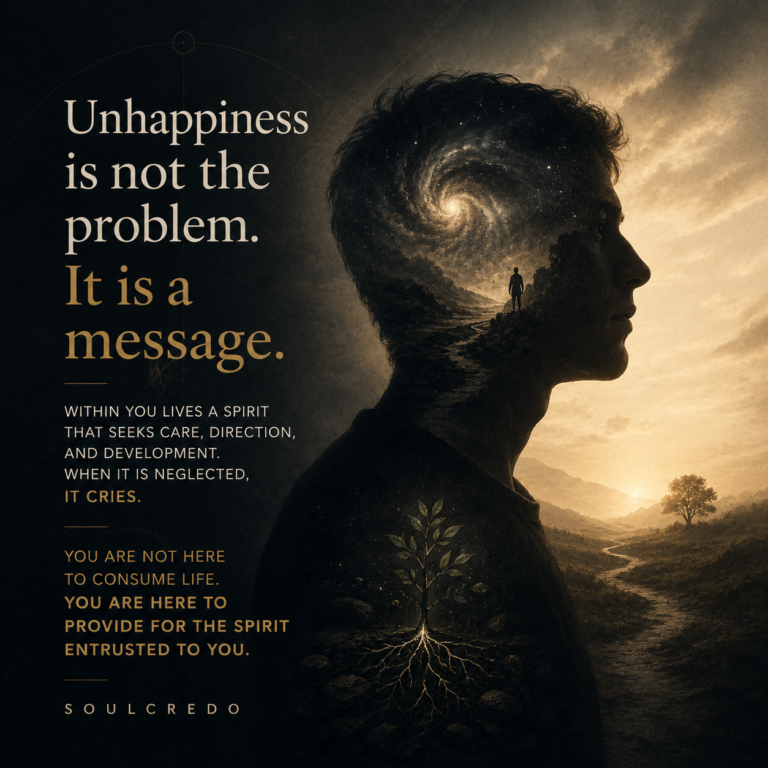
Could it be that unhappiness, with all its associated pain and darkness, is an indication that your soul—your inner home—is in disarray?
If so, unhappiness is not merely a burden. It may also be a direction—an order to act, to restore order within the soul and put your inner home in its proper condition.
In this sense, unhappiness may be positive, not because suffering itself is good, but because it reveals that something requires attention. When we understand its message and act upon it, happiness may arrive—and remain, at least for a time.
Why Spirited Souls Are Unhappy?
Why is my soul unhappy when the majority is blessedly enjoying life?
Why do feelings of worthlessness and of the emptiness of existence flood my soul when it seems there are no apparent reasons for it. Why does my soul suffer, and its pain suffocates my life?
Why is my soul restless and unsettled when most people around me neither understand nor recognize this pain as real—and when I open my soul to them, they shun and ridicule me, causing even more pain?
This problem has puzzled me since early childhood. This problem poisoned and still poisons my life, bringing a terrifying amount of unnecessary soul suffering.
I am talking about pain that comes NOT from a necessity but rather the pain coming from the depths of your soul, the psychological pain. This pain usually comes when life is generally good. Something inside of our souls always wants more, demanding more – pushing us forward but never giving us directions or advice – Causing unhappiness. This unhappiness as the state of the soul is creating this “Monster Feeling.” It is the feeling of being unworthy, unloved, unnecessary, or somehow lesser than others—the feeling of being a failure. That is why answering the question “What is happiness?” is so important.
Why do our souls suffer when everything appears to be fine? What inside us wants more? What does it desire? Why does it mercilessly torture us? Where is it directing us? Where is it forcing us to go? What is this “beast” within?
We are oftem lost. Our souls are unsettled. Our minds wander purposelessly; we are directionless. To escape unhappiness and find this elusive happiness, we try many different things, but all instead bring more suffering, amplifying pain to the degree of unbearable.
Why Unnecessary Sufferings Suffocate Us?
All of us desire happiness. Yet many, if not most of us, suffer. Our souls are filled with anger, fear, envy, hate, and darkness.
True happiness, love, joy, belonging, and prosperity are rare in our lives, while the rule of suffering triumphs … The tyranny of suffering is overwhelming. Its roaring hell is controlling us unchecked and unchallenged … This atrocity exists mainly because we do not understand and not devote ourselves to the reason we are here in this realm. For that, we suffer much, yet mostly needlessly and unnecessarily.
We continuously seek happiness, only to constantly find suffering – We are lost, we are confused, and we are in the dark – In this bewildering existence, we relentlessly torture ourselves and others … All of it, only because we are unconscious of what we are, of why we are here; of what our purpose is.
Why do Unnecessary Sufferings suffocate us; Why do they stay between us and our happiness? The answer is profoundly simple; it is because we do not live according to what we are supposed to live.
When searching for their own Happiness, most people find Unnecessary Suffering instead because they search outside of the scope of life’s meaning and purpose. We must constantly remind ourselves that true happiness resides only within the confinement of meaningful and purposeful existence.
It is a case of this banal duality of existence: To be happy, one must be healthy, prosperous, and have meaningful relations. To have all of these, one must commit to a life of purpose. The problem here is that we know little about the meaning of life, thus having difficulties living a life of purpose. Instead, we find only suffering when we are in a frantic search for happiness. And this circle is the fate of the majority.
Unnecessary suffering often shadows the soul when we fail to commit to the path we sense is right for our lives. And as a result, acquired unhappiness translates into bad health, financial struggles, relationship difficulties, and an inability to ensure stability.
Yet, our desire for happiness is not a delusion as one may say, it is a call for action.
The Ontology of Happiness

In his work on ethics, Aristotle said that happiness is the only thing that humans desire for their own sake, unlike riches, honour, health or friendship.
See, we all innately desire Happiness. We tirelessly search for it. We are all on this quest to find happiness. Yet, this search mostly delivers suffering instead, and they are mostly unnecessary. To obtain life’s happiness and not to suffer unnecessarily, we must break this loop. So, here is how I see it: … life is neither wicked nor vindictive. We simply do not know what to do with it. For that, we suffer much, yet mostly needlessly and unnecessarily. Life has a meaning, and our souls have a purpose. To find earthly happiness, we must commit to a life of spiritual meaning and purpose.
I believe that, as souls in this realm, we are the guardians of the Spirit. And protection of Life, Spirit’s carrier, is our exclusive purpose. It is humanity’s joint job until replaced by a verified successor. Upon mission completion, we will join God, we become It, we go home. This is the reward. It is what feeds our enthusiasm for life; it is also why we suffer here and now.
It is what this drive for happiness is. It is why we are driven to find happiness. It is the need to fulfil the job of life in the most effective and productive way. It is why it is the truth that we are here in this realm for one reason – To obtain Happiness and experience it. We are here to have a life filled with joy & inner peace. Be surrounded by love & beauty. Enjoy a life saturated with an abundance of health, meaningful relations, belonging and success.
Know what made you – The life. And your creator wishes you a lifetime of happiness. However, it also demands it, and those who refuse to take care of life are suffering unnecessarily. What is happiness if not a commitment to the path of personal life purpose? The real reward for this commitment is not happiness. The real prize is a life demarcated from the majority of Unnecessary and needless Sufferings that otherwise flood the lives of those who do not.
Consciousness as the Spirit Realizing Itself
What is consciousness?
We usually speak of it as if it belongs to us entirely. As if it were merely the brain talking to itself. Yet I believe consciousness is something deeper. It is the Spirit realizing itself within the soul.
We usually speak of consciousness as if it belongs to us entirely. As if it were merely the brain talking to itself. Yet I believe consciousness is something deeper. It is the Spirit realizing itself within the soul.
This is also why the question of consciousness after death cannot be separated from the question of what consciousness is while we are alive. If consciousness is only an activity of the physical brain, death ends it. But if consciousness is Spirit becoming aware of itself through the living soul, then the death of the body may not be the death of everything that became conscious within it.
The Spirit does not remain silent inside us. It reveals itself. We hear it in thoughts, intuitions, desires, fears, restless questions and these strange inner demands that never leave us alone. It is why we are not satisfied simply to eat, sleep, survive and reproduce. Something inside insists that life must mean more. Something demands that we become more.
This is the gift of consciousness, yet it is also the burden.
The question “What is happiness?” cannot be separated from the question of consciousness, because only a conscious being can recognize the distance between its present life and its unrealized potential.
Because of consciousness, we create civilizations, philosophy, science, art, religion and technology. We ask what life is, why we are here and what we are supposed to become. We can imagine futures that do not yet exist and compare them with the life we are living now.
And from this comparison, suffering is born.
The animal suffers from hunger, injury, fear and danger. Yet the conscious soul can suffer when nothing obvious is wrong. The body may be healthy. The roof may be secure. Food may be present. Still, something within cries.
Why?
Because consciousness allows the Spirit to recognize what has not yet been realized. It sees unused ability, neglected purpose, unlived possibility and the distance between what we are and what we could become.
This inner pain is not always an illness. It is not always proof that life is cruel. Often, it is the pressure of the Spirit within, demanding movement.
Yet we misunderstand this pressure. We call it emptiness, worthlessness, failure or unhappiness. We run from it into entertainment, consumption, status, ideology and every other hiding place the world offers.
But consciousness gives us no permanent escape from ourselves.
It keeps returning us to the same questions:
Who am I?
What am I doing with my life?
What within me has not yet been born?
What does the Spirit demand of me?
In the SoulCredo philosophy, consciousness is therefore not merely awareness. It is responsibility. It is the Spirit within becoming visible enough to demand care, direction and realization.
To become conscious is not only to know that you exist.
It is to know that something within you expects you to become.
Material Happiness and the Search for Meaning
Let us dig a little bit deeper into this issue. Is material all that there is about happiness? Most of us, to one degree or another, associate a good material life with happiness, yet we also know that good material life does not deliver happiness. It is why we start to look for life’s meaning. After a while, we begin the new loop: material happiness, pain, and back to empty contemplations about life. But where to look, where to find the answer, who is the authority on this subject matter?

It is the reason why most of us desire to find happiness. We tirelessly search for it. Yet, the search for Happiness usually delivers suffering of an unnecessary kind. To obtain life’s happiness and not to suffer unnecessarily, we must break this loop.
So, here is how I see it … life is neither wicked nor vindictive. We simply do not know what to do with it. For that, we suffer much, yet mostly needlessly and unnecessarily. Life has a meaning, and our souls have a purpose. To find earthly happiness, we must commit to a life of spiritual meaning and purpose.
I will repeat it here. I believe that, as souls in this realm, we are the guardians of the Spirit that resides within our souls. And protection Spirit is our exclusive purpose. It is the job of each individual and humanity’s joint position until we are all replaced by a verified successor. Upon mission completion, we will join God, we become It, we go home. This is the reward. It is what feeds our enthusiasm for life; it is also why we suffer here and now.
However, most of us are also lost in this realm. We have no idea who we are here and why we are here. It is why we endlessly ask this question: What is the meaning of life, and what is the purpose of my existence?
Yet we have this drive within – and that is what we call the quest for happiness. It is why we are almost possessed to find happiness. It is simply the desire to commit to a life of meaning and purpose.
It is what this drive for happiness is. It is the need to fulfil the job of life most effectively and productively. As we are here in this realm for one reason – to meet the obligation of Spirit’s caregiver and in it to find happiness and experience it. We are here to have a life filled with joy & inner peace. Be surrounded by love & beauty. Enjoy a life saturated with an abundance of health, meaningful relations, belonging and success.
Know what made you – The Spirit. It assigned you a job to take care of life in general and your own life. And your creator wishes you a lifetime of happiness. However, it also demands it, and those who refuse to take care of life the appropriate way are suffering unnecessarily.
To conclude. What is happiness if not a commitment to the path of personal life purpose? Where the real reward for this commitment is not happiness per se. The real prize is a life demarcated from the majority of Unnecessary Sufferings that otherwise flood the lives of those who do not.
Happiness as a Duty to Life
Many, if not most, suffer, their souls filled with anger, fear, envy, hate, and darkness. We are obliged to take care of health, well-being and material things, as our body carries the Spirit. And The Spirit is what made Life & Life needs You … Life will help you with everything; You only need faith and desire to learn the meaning of life and commit to a life of purposeful happiness.
True happiness, love, joy, belonging, and prosperity are rare in our lives, while the rule of suffering dominates … The tyranny of roaring hell is controlling us unchecked and unchallenged … This atrocity exists mainly because we do not understand and not devote ourselves to the Life of Personal Purpose – for that, we suffer much, yet mostly needlessly and unnecessarily – We must revolt, we must join the cause of The Universal Spiritual Cause.
We continuously seek happiness. We tirelessly try to find happiness. Yet instead, we only constantly find Sufferings – We are lost, we are confused, we are in the dark – In this bewildering existence, we relentlessly torture selves and others … All of it, only because we are unconscious of what we are, of why we are here; of what our Purpose is.
Why do unnecessary sufferings suffocate us; Why do they stay between us and our happiness? The answer is profoundly simple, it is because we do not live a life of purpose. It is my answer and of SoulCredo’s.
When searching for their own happiness, most people find unnecessary suffering instead because they search outside of the scope of life’s purpose. As true happiness resides only within the confinement of purposeful existence.
It is a case of this banal duality of existence: To be happy, one must be healthy, prosperous and have meaningful relations – And to have all of it, one must commit to a life of purpose. The problem here is that we know little about the meaning of life, thus having difficulties living a life of purpose. Instead, we find only suffering when we are in a frantic search for happiness. And this circle is the fate of the majority.
Unhappiness is always shadowing us as a direct outcome of not knowing our purpose; And acquired unhappiness translates into bad health, financial struggles, relationship difficulties, inability to find an occupation to which to commit with passion etc.
The SoulCredo Path to Life’s Happiness
So, what is the solution, how to find happiness in life?
The definitive answer is simple … Commit to Self-Discovery and realize the inner self. Understand life’s meaning. Know your life purpose … Commit to a life you are here for, and then find the happiness you will.
I will repeat: We are here to enjoy a life of happiness: Life of joy and inner peace – Life surrounded by love and beauty – Life saturated with an abundance of health, success, meaningful relations and belonging.
It is why we desire happiness, why we search for it – yet life’s happiness is found nowhere, only suffering we know well.
However, life is neither wicked nor vindictive. It provides us with all that is needed for Happiness. We simply do not know what to do with life. For that, we suffer much, yet mostly needlessly and unnecessarily… life has a meaning, and your soul has a purpose … To enjoy happiness, you must commit to it.
And remember the one who ceases to wring happiness from life with force—ceases to wound its essence—and instead begins to embrace life’s meaning and purpose with reverence, becomes a gentle magnet for happiness. This happiness, no longer fleeting or reluctant, comes swiftly, lingers willingly, and stays as long as it is truly needed.
By summoning happiness this way, you liberate yourself from the tyranny of unnecessary suffering. And with this liberation, happiness brings companions—inner peace, profound wisdom, radiant health, true love, belonging, steadfast friendship, meaningful success, and prosperity rooted in purpose.
So, to end the tyranny of unnecessary suffering and to live lives of meaningful happiness, we must revolt and overthrow the tyranny of unnecessary suffering. We must learn to live fulfilled lives to become accomplished and prosperous individuals.
Conclusion: What Is Happiness?
So, what is happiness in the SoulCredo philosophy? It is not constant pleasure, but a life increasingly aligned with the demands of the soul, the purpose of the Spirit, and the responsibilities of existence.
Happiness is not a permanent state of pleasure, nor is it a life without difficulty, disappointment, fear, or loss. It is the experience of life becoming more meaningful, more coherent, more loving, and more aligned with who you are and what you are here to do.
A happy life is not created by one achievement, one relationship, one possession, or one moment of success. It develops when the essential parts of life begin to support one another: health, inner peace, love, belonging, purposeful work, practical stability, self-respect, spiritual meaning, and hope for the future.
The search for happiness often becomes painful because we look for it outside ourselves. We chase approval, status, pleasure, recognition, or comfort while avoiding the deeper questions of identity, responsibility, meaning, and purpose.
But unhappiness is not always an enemy. At times, it is a signal that something within life requires attention. It may reveal that we are living without direction, neglecting our strengths, abandoning meaningful responsibilities, or trying to become someone we were never meant to be.
The SoulCredo path to happiness begins with self-discovery. It asks us to understand our inner nature, recognize our strengths and talents, identify our purpose, and express that purpose through action in the world.
This path does not promise a life without suffering. It promises something more realistic and more valuable: a life in which unnecessary suffering gradually loses its power, while meaning, love, belonging, inner peace, and meaningful prosperity become stronger.
Happiness is therefore not merely something we find.
It is something we move toward.
It is a guiding force that calls us to become more conscious, more responsible, more purposeful, and more capable of caring for life—our own life and the lives of others.
To live happily is not to escape reality. It is to meet reality with greater understanding, courage, order, and purpose.
And perhaps this is the clearest SoulCredo answer to the question:
Happiness is a life increasingly aligned with the inner self, personal purpose, meaningful prosperity, love, belonging, health, and spiritual meaning—and increasingly free from unnecessary suffering.
Frequently Asked Questions About Happiness
What is happiness in simple words?

Happiness is the experience of life feeling meaningful, emotionally bearable, and worth living. It includes positive emotions such as joy, love, hope, gratitude, and inner peace, but it is more than a temporary pleasant feeling. Happiness also depends on relationships, purpose, health, belonging, progress, and freedom from unnecessary suffering.
What is the true meaning of happiness?
True happiness is not permanent pleasure or a life without difficulty. It is a condition in which the major parts of life—inner peace, love, health, purpose, belonging, meaningful work, practical stability, and spiritual meaning—support one another. A happy life can still contain sadness, uncertainty, loss, and struggle.
Is happiness a feeling or a way of life?
True happiness is not permanent pleasure or a life without difficulty. It is a condition in which the major parts of life—inner peace, love, health, purpose, belonging, meaningful work, practical stability, and spiritual meaning—support one another. A happy life can still contain sadness, uncertainty, loss, and struggle.
What is the difference between happiness and pleasure?
Pleasure is an enjoyable experience, while happiness is a broader condition of life. Pleasure asks whether something feels good in the moment. Happiness asks whether it contributes to a life worth living. Pleasure can support happiness, but it cannot replace purpose, meaningful relationships, self-respect, or inner peace.
Why is happiness difficult to find?
Happiness is difficult to find because people often search for it through status, approval, possessions, entertainment, or one final achievement. These things may improve life, but they cannot resolve every inner conflict. Happiness also becomes difficult when we lack self-knowledge, meaningful direction, emotional stability, or realistic expectations.
What is the relationship between happiness and purpose?
Purpose gives happiness direction. It helps organize effort, responsibility, talent, relationships, and personal growth around something meaningful. Purpose does not have to be one grand mission. It may appear through work, caregiving, creativity, learning, service, family, spiritual commitment, or contribution to others.
Can a person be happy while still suffering?
Yes. Happiness does not require the complete absence of pain. A person may experience grief, illness, fear, disappointment, or uncertainty while still believing that life has meaning and value. The aim is not to eliminate all suffering, but to prevent unnecessary suffering from controlling the whole of existence.
How does SoulCredo define happiness?
SoulCredo defines happiness as the movement of life toward greater alignment with the inner self, personal purpose, meaningful prosperity, love, belonging, health, and spiritual meaning, accompanied by a reduction in unnecessary suffering.
The SoulCredo path can be summarized as:
Self-discovery → understanding strengths and talents → identifying purpose → purposeful action → meaningful prosperity → reduced unnecessary suffering
How can I become happier?
Begin by identifying what causes unnecessary suffering. Examine your values, strengths, neglected needs, relationships, health, responsibilities, and sense of direction. Strengthen the foundations of life gradually. Happiness is usually built through meaningful progress, not discovered through one dramatic event.